

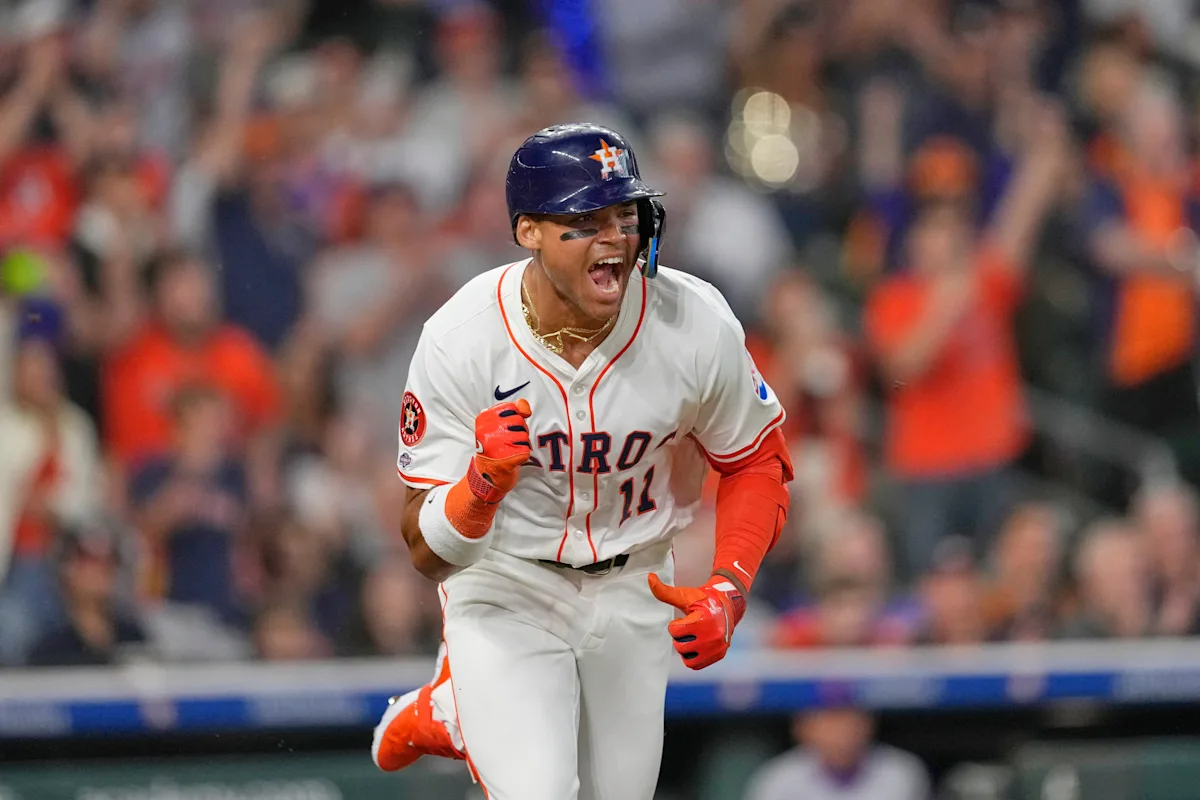
In Houston, all eyes are fixated on the grand return of slugger Yordan Alvarez at the moment. The Astros’ DH reached 10 home runs yesterday, becoming the first MLB player to do so this season.
Obviously, there’s no shortage of rationale for the commotion that Alvarez is causing. Like everyone else, we covered Alvarez’s hot start the other week on this site.
It might sound crazy with how he’s mashing, but Alvarez actually might not end up as the Astros’ biggest story. Yes, the man currently on pace for 73 home runs may not get the most attention on the Astros when it’s all said and done.
Instead, young outfielder Cam Smith could be the player turning heads. Entering his sophomore season, Smith has transformed his approach at the plate. In addition to extreme mechanical changes, this youngster looks destined to break out.
MLB’s Largest Increase in Bat Speed
In 2026, Cam Smith is swinging the bat 3.5 mph harder than he did in his rookie season. Among qualified players, that increase is the largest in the sport, almost by a full 1 mph.
The wild aspect of this development is that Smith already possessed a very powerful swing prior to 2026. Last season, Smith’s average bat speed of 74.5 mph landed just outside the top 15% of all qualifiers.
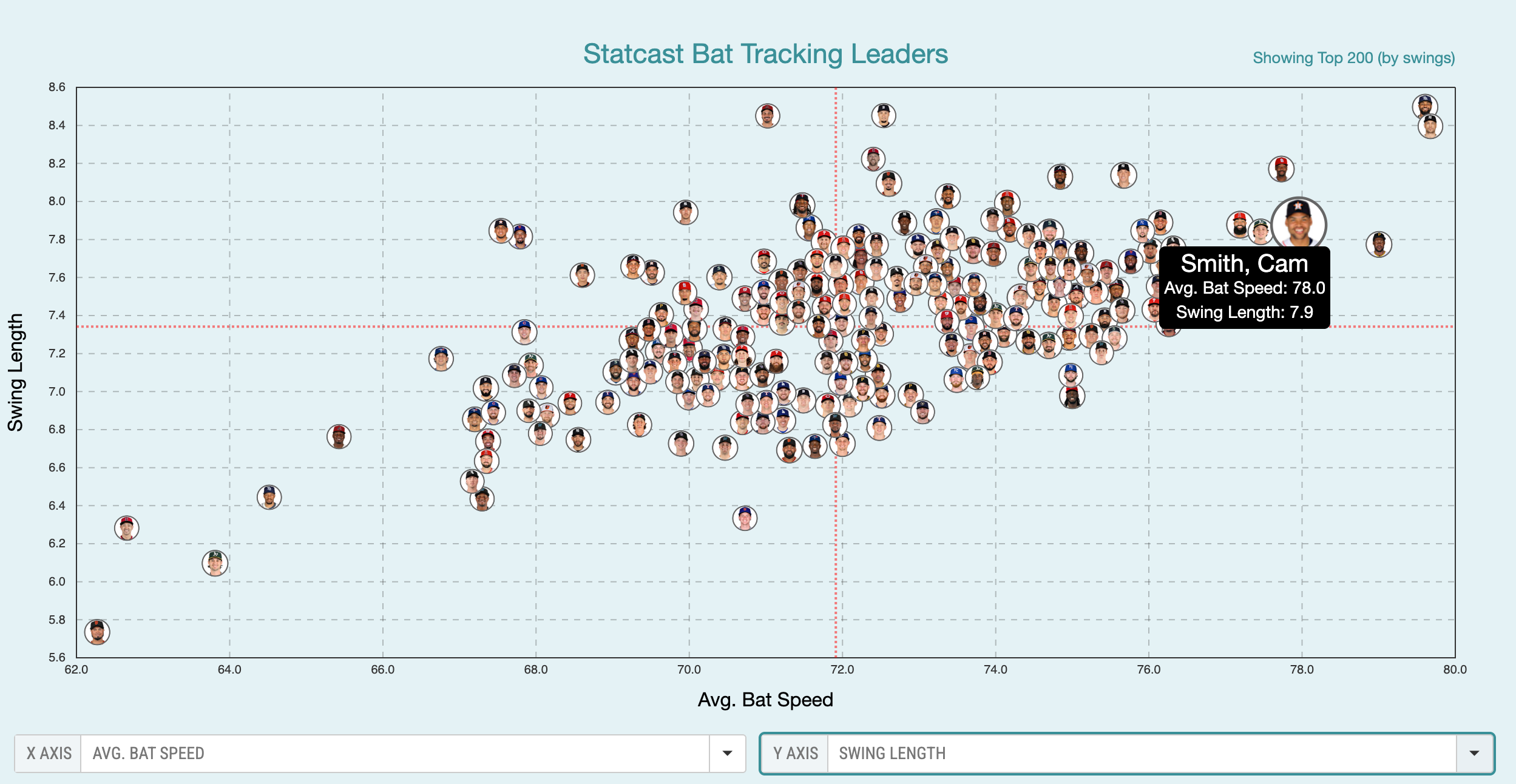
Currently, Smith’s hack actively ranks as the fourth-fastest swing in the entire league. Only the power giants Giancarlo Stanton, Oneil Cruz, and Junior Caminero wield faster swings.
Now, the immediate thought in mid-April is that the sample size is small. However, unlike basic stats like AVG and OPS, bat-tracking data stabilizes extremely quickly. Research on bat tracking has revealed that season-long averages can often be determined after a player’s first 10 swings.
So yes, barring another unexpected profile makeover, Smith’s new surge of power is legit. However, how will this improvement translate to improved results?
Predicting Results Using Bat-Tracking Data
Since Statcast introduced bat-tracking data in 2024, the metrics have flourished as predictors for both contact and power outputs. Both swing length and bat speed are now commonly used as key factors in evaluating players, specifically in terms of power.
In Cam Smith’s case, he didn’t just add bat speed. Right now, Smith’s swing is 0.6 feet longer than it was in 2025, which is—you guessed it—also the largest year-over-year increase of any player.
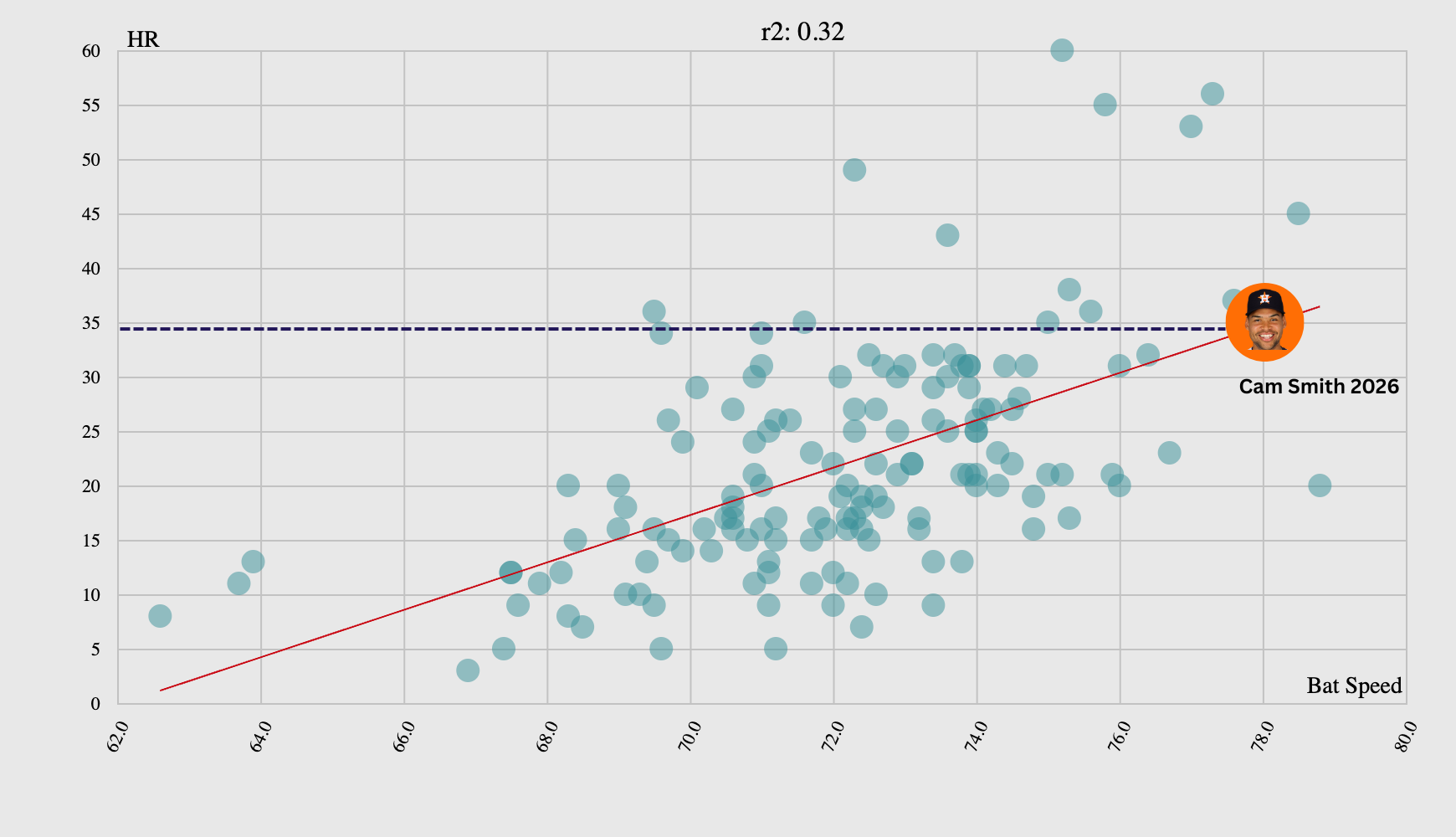
Using those stats as predictors based on 2025 regular-season data, Smith’s home run projection soars into the 30-homer range. Here are the projections, along with variable correlations:
-
Using Bat Speed (0.32 correlation): Projected 34 HR
-
Using Swing Length (0.22 correlation): Projected 28 HR
Paired with his near-average strikeout rate, this is the build of a serious power hitter. Keep in mind that when Smith cracked the Opening Day roster last season, he was viewed as more of an “athletic” and “balanced” hitter rather than a power threat.
Impressive Early Returns
At first glance, Smith’s start to the 2026 season doesn’t look all that impressive. He’s batting .241 so far with three home runs and a .751 OPS. While that’s an above-average hitter, it’s not “breakout” worthy yet.
What has been impressive is his batted-ball data. Smith’s hard-hit rate ranks in the top 20% of all hitters, and his barrel rate lands up in the top 8%. While these stats can be impacted more by early-season noise, they stand out distinctly from his 2025 marks.
In 2025, Smith’s quality-of-contact metrics lacked severely, especially for a player with plus bat speed. Considering his physical tools, it’s all but certain that timing and swing path issues strongly impacted his exit velocities.
Yet again, Smith has already shown a willingness to adjust in 2026. He slightly flattened his swing and is meeting the ball at a steeper attack angle, which is leading to more fly balls and line drives. Once again, the early batted-ball data validates his tweaks. Smith’s ground-ball rate is down by 3%, and his fly-ball rate is up by 6.6%.
Smith’s story of mechanical adjustments is repeatedly narrated by his early batted-ball data. The only piece that’s missing is better in-game results that would draw him more attention. However, don’t let that .241 AVG fool you. Smith is on the verge of adding another star to this Houston Astros era.

77 Comments