

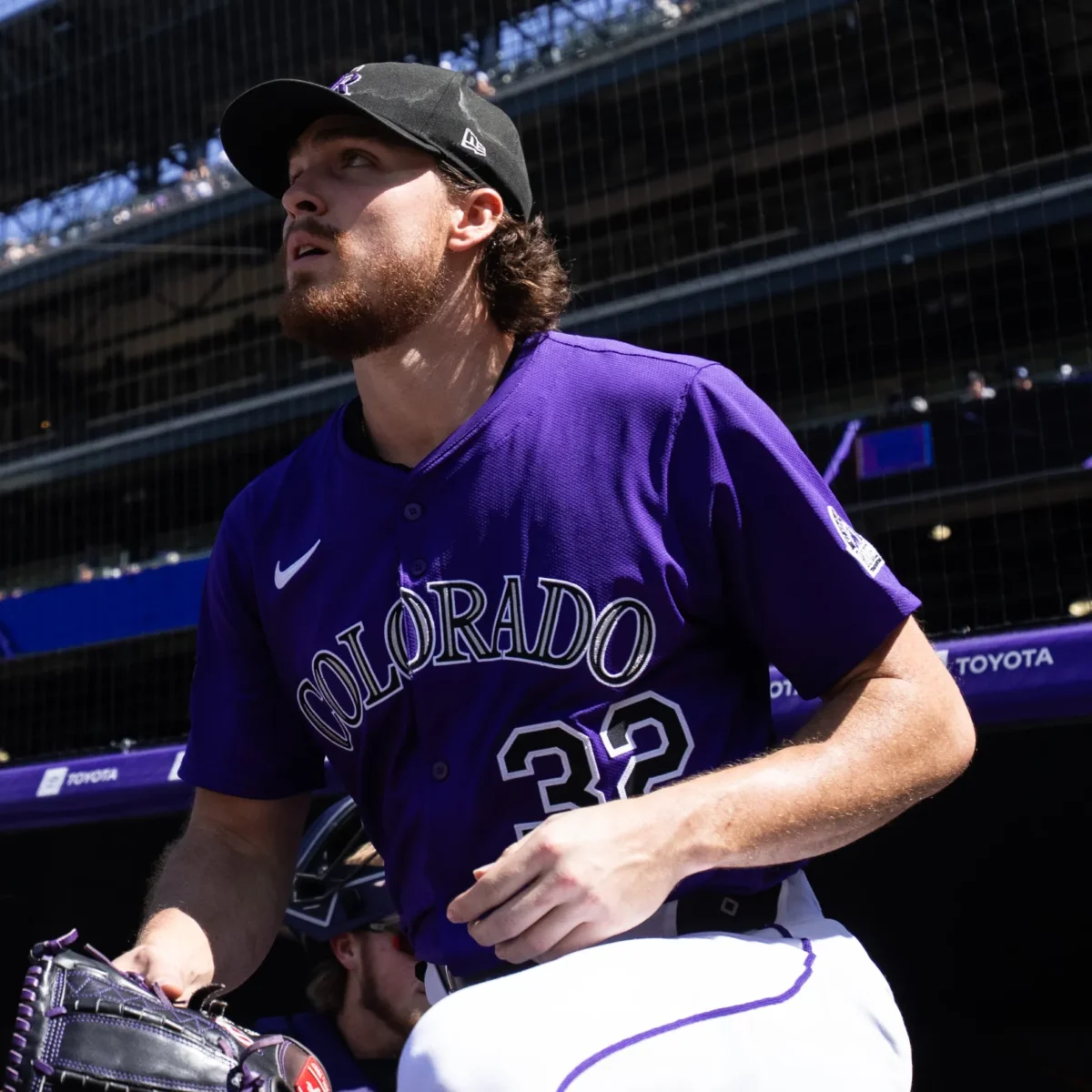
In 2026, the Colorado Rockies could be sending a pitcher to the All-Star Game for the first time in five years. For the first time since Germán Márquez in 2021, the Rockies appear to have a standout pitcher on their roster.
Through eight outings, Chase Dollander is humming to the tune of a 2.25 ERA. Across 32 innings, he’s punched out 39 batters and walked only nine.
The 24-year-old, drafted ninth overall in 2023, has always had lethal stuff. As a prospect, he was credited with possessing “frontline starter stuff,” despite concerns with “commanding his premium pitches,” per MLB Pipeline.
Dollander debuted early in 2025 in a normal starter role. It seems like that should go without saying, but his role actually plays a huge part in this development.
The youngster allowed a nightmarish eight homers in his first three starts, two of which came at Coors Field. While Dollander made 18 more starts, he never truly settled in statistically. His ERA dipped under 6.00 only once all season.
When it was all said and done, Dollander allowed 71 earned runs across 21 starts, resulting in a 6.60 ERA. Playing at Coors Field, his 9.98 ERA became the highest home ERA by a pitcher with at least 10 starts at home in MLB history.
That’s far from ideal for any rookie season. However, it was especially shocking for a prospect of Dollander’s pedigree.
Fortunately for Dollander, he never lost that pedigree, even while ending up on the wrong side of history.
Small Tweaks, Fixing Drastic Problems
Beyond both his successes and struggles, Dollander has never lacked nasty stuff. His average fastball is 98.8 mph and has touched 101 on multiple occasions.
Chase Dollander 💯⛽️ pic.twitter.com/dlbvYjE0Xn
— Rob Friedman (@PitchingNinja) April 26, 2026
Dollander also features a sharp slider with above-average velocity, drop, and sweep. He throws a changeup with a good drop, as well as a toss-in curveball and sweeper.
Reading that arsenal out loud, it seems impossible that he ran a 6.00+ ERA in 2025. However, he played directly into his weaknesses and quite literally allowed nature to work against him.
I’m talking about altitude and the effects it exerts on vertical pitch movement. In 2025, Dollander threw his four-seam fastball and curveball a dominant 70% of the time. Because his pitches always broke north-and-south—which was strongly limited by the altitude—his fastball entered the so-called “dead zone.”
Some examples of pitchers who’ve battled cases of the “dead zone fastball” include Roki Sasaki, Kumar Rocker, and Edward Cabrera. While Sasaki is still holding strong (notably without much success), Rocker and Cabrera have both pivoted to throwing sinkers predominantly (and have each seen improvement).
Dollander’s early 2026 success has been underscored by an ongoing transition toward higher sinker usage. While he’s still relying on a four-seamer more often, he’s throwing his sinker more than twice as often as he did in 2025. It’s become his second-most used pitch, and all of a sudden, he ranks in the top 2% of the league in fastball run value, according to Statcast.
Chase Dollander, Nasty 99mph Sinker. 😨 pic.twitter.com/KjbJfxBs8M
— Rob Friedman (@PitchingNinja) April 26, 2026
He’s also drifting away from the curve. Dollander now opts for his slider more often and, as you’d expect, is having more success with it. The added touch of horizontal break works better off his fastball, especially when playing at Coors Field.
A Superstar… Long Relief Pitcher?
If you look closely, you’ll notice I haven’t mentioned anything about Dollander actually starting games in 2026. That’s because he really hasn’t. By the box scores, Dollander has only made one start and serves as a long relief pitcher.
However, it’s a bit more technical than that. Under new pitching coach Alon Leichman, the Rockies have developed a curious new strategy that’s unique to their squad. The traditional starting rotation strategy has been all but scrapped.
Instead, nine different Rockies pitchers have made starts, including one from Dollander. While some of these starts are typical 4-6 inning outings, others have been as short as three batters. Colorado has utilized a one-inning opener on several occasions before handing the ball to multi-inning arms, most notably Dollander.
The curious idea of hiding Dollander from the first inning has worked to perfection so far. Here’s how his five most recent outings have fared:
-
April 9 @ SD: 4.1 IP, 1 ER, 4 H, 1 BB, 3 K
-
April 12 @ SD: 1.0 IP, 1 ER, 1 H, 0 BB, 0 K
-
April 16 @ HOU: 5.1 IP, 0 ER, 1 H, 2 BB, 9 K
-
April 21 vs. SD: 6.0 IP, 1 ER, 3 H, 1 BB, 9 K
-
April 26 @ NYM: 7.0 IP, 0 ER, 5 H, 2 BB, 7 K (started game)
Chase Dollander in April:
21 IP
27 K
1.71 ERA
0.86 WHIPCareer-high 9 K in back-to-back games.pic.twitter.com/lHSqOJJpdg
— Underdog MLB (@UnderdogMLB) April 22, 2026
To break it down, that’s three bulky long relief outings, one long start, and one single-frame appearance. In this new Rockies unit, there truly are no rules. Anyone could come out of the bullpen each game, and anyone could make the start.
It all comes down to analytics and matchups in the end. As of now, Dollander has been deemed most effective when he enters in the second inning. To this point, Alon Leichman and manager Warren Schaeffer have been spot-on.
So, with this role working to perfection, could we be seeing a breakout long relief pitcher? There are no real “star” long relief pitchers in the league today. The Yankees’ Ryan Yarbrough—who joined the Team USA roster for the World Baseball Classic—is the only long relief arm that I can recall getting any sort of recognition.
While he’ll have to show some endurance, Dollander looks well on the way to creating a category of his own. With top-of-the-line stuff, now optimized to the park he plays in, we’re finally seeing the vision that Colorado saw on draft night.
These Rockies may slide into last place once again. However, this is a much-improved group. Their 13-16 record doesn’t appear special, but to Rockies fans, it’s a major improvement. In 2025, Colorado didn’t secure their 13th win until June 12.
So, that should tell you how different the energy is in Colorado this season. The pitching has been the driving force, spearheaded by Dollander’s complete 180 as a pitcher.
At this rate, Dollander will be representing the Rox in Philadelphia in the middle of summer.
668 Comments