


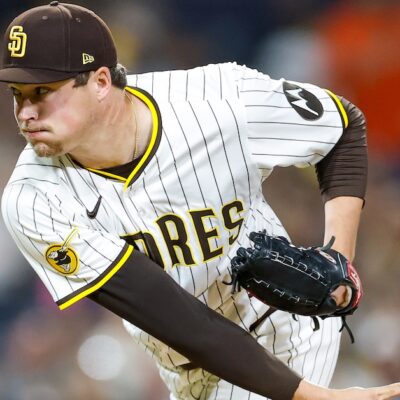
Five years ago, a 22-year-old Fernando Tatis Jr. arguably became baseball’s most captivating superstar. He was an electrifying five-tool shortstop powering a rebranded, rising San Diego squad. Tatis Jr. rose to become a face of the game rapidly, and career expectations ran wild.
However, his popularity came to a screeching halt in 2022 with one of the more disappointing stories in recent history. Recovering from an offseason wrist injury, the Padres’ shortstop targeted a return to the field in the second half. However, just days before his return, it was announced that he had violated MLB’s Joint Drug Prevention and Treatment program.
The result was an 80-game suspension that extended Tatis Jr.’s absence to a whopping 194 games, including the 2022 postseason. Upon returning, Tatis Jr. showed flashes and streaks of his old, MVP-caliber self.
However, in the big picture, Tatis Jr. is far from the hitter he once was. Now with three years of data and counting, the results have told a different story. While he’s still been an above-average hitter, Tatis Jr. has massively lacked the slug he once flashed.
In 2026, Tatis Jr. is off to the worst 30-game start of his career. He is one of just eight qualified hitters without a home run this season. Despite the Padres’ strong start to 2026, the face of their franchise has made little impact at the dish.
While the stat sheet wouldn’t suggest it, Fernando Tatis Jr. is still just as powerful at the plate, if not more so. His hard-hit rate actively leads all qualified hitters, and he’s seeing increases in exit velocity and bat speed.
With that quality of contact, it’s impossible to imagine that he’s still without a big fly in 2026. However, you’d be surprised to hear that shoulder surgery is the direct culprit of his missing power results.
The Labrum Surgery
Following his suspension in 2022, Fernando Tatis Jr. used the downtime to get a procedure on the shoulder that had been nagging him for a while. He’d been dealing with a recurring torn labrum and got surgery in September 2022.
The nature of the surgery is simple but turned out to be detrimental for Tatis Jr. In the operation, the anterior capsule of the shoulder joint was tightened to prevent the humerus from slipping out. The direct trade-off? Increased stability in exchange for flexibility and range of motion.
The effect of this trade-off plays a major role in the swing. In order to pull a baseball, the lead shoulder needs to pull backward to create the necessary space for the barrel to stay on plane. To elevate a baseball, the lead shoulder needs to pull upward to create the necessary space for the barrel to hit the bottom part of the ball.
This limitation of flexibility has forced a serious change in how Tatis Jr. attacks pitches. Before the surgery, he was very upper-body oriented and could pull seemingly any pitch, anywhere. Take a look at an example swing from 2021, where he’s able to use his flexibility and raw upper-body strength to launch a breaking ball:
However, that ability to just “drop the head” on any pitch and send it to the pull side is all but gone. Now, Tatis Jr. relies far more heavily on his lower half and core, which helps him generate torque without much help from the shoulder. Here’s an example of a home run from 2025, where he uses his lower body almost exclusively to turn on the baseball:
The first thing you should notice is that his raw strength is aplenty, and he doesn’t need to worry about generating power with his swing. Swing path and plate coverage should be the main focus points for his mechanics.
However, the second thing you should notice is that his shoulder movement is almost nonexistent in the second video. Compared to the first video—where his shoulder drops and turns in a flash—it looks like a completely different swing.
The Effects and the Evidence
As you may presume, this issue has caused a catastrophic decline in both pull and fly-ball rates. While he found his way out of the hole at times, the overall data suggests there’s a new version of Tatis Jr. at the plate.
Since peaking in 2021, here’s where Fernando Tatis Jr.’s pull-air rates landed:
-
2021: 22.2%
-
2023: 15.1%
-
2024: 14.5%
-
2025: 12.0%
-
2026 (30 G): 6.2%
That’s as steady of a decline as they come. Considering that a bulk of his 42 home runs in 2021 came to the pull side, his recent batted-ball index cuts that potential in half, at the very least.
Still Elite, Without the Tanks
Despite the fact that Tatis Jr. hasn’t eclipsed the 30-homer mark since his return, he’s still been one of the game’s best. An All-Star in 2024 and 2025, Tatis Jr. has found a new identity as a player while still possessing the same energy.
Elite defense, now in the outfield, underscores the continued stardom of Fernando Tatis Jr. While he’s clearly fallen behind other sluggers like Juan Soto, Ronald Acuña Jr., and Vladimir Guerrero Jr., he’s remained just as valuable.
In 2025, Tatis Jr. posted the following non-power stats:
-
.368 OBP
-
+8 Outs Above Average
-
95.5 mph Arm Strength
-
+5 Baserunning Run Value
This comes on top of an .814 OPS, which made him the ninth-most valuable player in baseball last season.
While his MVP-caliber power surge may never return, Fernando Tatis Jr. still has all the tools to remain one of the game’s best. With top-of-the-line athleticism, he simply repurposed himself to remain elite while contributing elsewhere.
118 Comments