

Aggressive roster construction league-wide is pushing the concept of a “contract extension” to extremely risky levels
*This article was updated on Thursday, April 2nd to reflect the agreement between the Pittsburgh Pirates and prospect Konnor Griffin on a nine-year, $140 million contract extension
It’s no secret that Major League Baseball players are earning more and more money by the year. Over the span of just a decade, the economic middle class of clubs have faded into small market territory.
Take a look at teams from the Central divisions such as the Reds, Brewers, and Tigers. In the year 2026, these deals remain the largest contracts each club’s history:
- Cincinnati Reds: Joey Votto – 10 year, $225 million free agent deal
- Milwaukee Brewers: Christian Yelich – 7 year, $188.5 million contract extension
- Detroit Tigers: Miguel Cabrera – 8 year, $248 million contract extension
- Chicago Cubs: Jason Heyward – 8 year, $184 million free agent deal
- Cleveland Guardians: Jose Ramírez – 7 year, $175 million contract extension
Guardians, 3B José Ramírez agree to 7-year extension through the 2032 season. pic.twitter.com/8fx0WHo4uI
— MLB (@MLB) January 29, 2026
All five of these squads played in the 2026 Postseason, without any $250+ million contracts on their books. These sort of teams, year after year, are forced to get creative in the front office. In this sector of the industry, scouting, player development, and trade market activity are relentless.
Manipulating service time, signing and trading veterans at the deadline, these strategies are mainstays in the competitive cycle of non-big market teams. However, a new trend has emerged, and it’s spreading like wildfire.
Early-career extensions
Offering multi-year contract extensions to highly touted prospects and young emerging stars is rapidly popularizing around the MLB. Naturally, these extensions are lengthy, but far cheaper than your typical contract extension.
At a glance, the concept would seem completely normal. Watch a young player thrive, and lock them down on a multi-year extension. Sounds simple, doesn’t it?
Take Padres centerfielder Jackson Merrill for example. At 21 years old, Merrill closely trailed Paul Skenes for NL Rookie of the Year honors in 2024. Merrill played 156 games, and showed the type of player he is, leaving no room for doubt.
A year later, Merrill inked a 9-year, $135 million contract extension within the first week of play. Historically, most fans would consider that a common extension scenario, if not a little early into the player’s career.
Padres, OF Jackson Merrill reportedly agree to 9-year extension, per multiple reports including @MLBNetwork insider @JonHeyman. pic.twitter.com/tuTGdvEwzB
— MLB (@MLB) April 2, 2025
Well, MLB front offices have moved on from that standard in a flash. Suddenly, prospects that have yet to step into a big league batters box are looking at extensions north of $50 million. This reached new heights earlier in the week, with the signing of two non-debuted prospects:
- Cooper Pratt, Brewers — 8 year, $50.75 million extension (Reported Monday, March 30th)
MLB Pipeline considers Pratt as the Brewers’ number four prospect. He is ranked as the No. 62 overall prospect in all of baseball.
However, Pratt has played just three games at the Triple-A level. In 2025, he posted a .691 OPS throughout 120 games at Double-A. He’s been scouted as a player who’s still finding their footing offensively.
Out of nowhere, the Brewers offered a $50 million extension to the 21-year-old that’s finding their footing offensively. There’s so much risk to a move like that, but the reward could be season-altering for years to come.
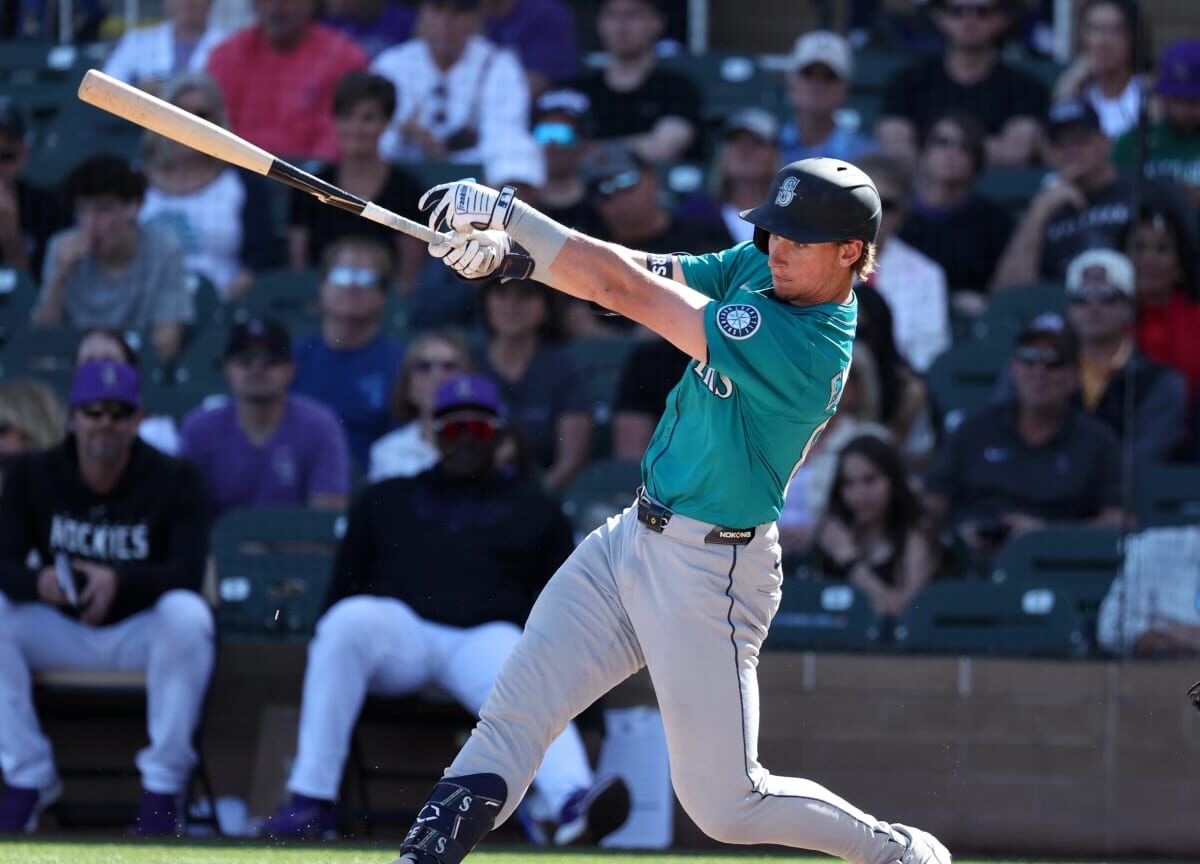
- Colt Emerson, Mariners — 8 years, $95 million extension (Reported Tuesday, March 31st)
Now, Emerson is a little different because there’s far more noise around his potential. According to MLB Pipeline, Emerson is the No. 7 overall prospect in the sport. He’s the clear-cut top dog in the Mariners’ system. For a player like Emerson, there’s a red carpet stretching from Triple-A Tacoma to Seattle waiting for him.
However, $95 million is the largest contract in league history for a player with zero big league at-bats. Emerson and Seattle shattered the previous record of $82 million that went to then-No. 2 overall prospect Jackson Chourio in December of 2023.
In 2019 and 2021, star outfielders Ronald Acuña Jr. and Byron Buxton signed $100 million extensions, respectively. Buxton had just posted an OPS over 1.000 in a 65-game, injury-shortened season. Meanwhile, Acuña Jr. posted a .918 OPS over 111 games in his rookie season prior to signing his extension. The common denominator? Both players proved themselves at the MLB level.
ACUÑA TIME!!
Ronald Acuña Jr. leads off with his 2️⃣0️⃣th home run of the season as the @Braves take an early lead. #Braves | #ChopOn pic.twitter.com/cBrD39hCog
— Braves On FanDuel Sports Network (@FanDuelSNBraves) August 22, 2018
Meanwhile, Emerson is looking at $95 million in guaranteed money without playing a single game in Seattle. The vision is clear (we’ll get into that next), but the risk feels unnecessary.
Konnor Griffin murmurings
It was announced early this morning that the consensus top prospect in all of baseball, Konnor Griffin, is being called up to debut for the Pirates on Friday in Pittsburgh. In this context, Griffin is likely to see major league at-bats before he or the Pirates can pull the trigger on an extension.
However, that doesn’t defer the fact that Griffin and the Pirates are reportedly discussing a potential extension, comfortably worth over $100 million. ESPN’s Buster Olney reported that Griffin’s camp is around the $130 million range, while the Pirates are hovering closer to $111 million.
Either way, this early extension trend reaching baseball’s number one prospect would be massive, regardless of whether he debuts or signs the paper first.
The motive behind the move
Pre-debut extensions are gutsy, but can reward teams for several years if the move pans out as hoped. For non-superstar money, a prospect than develops into a superstar is among the most valuable chips in the sport.
Imagine it this way: In two years, Colt Emerson reaches the caliber of Phillies’ shortstop Trea Turner.
Philadelphia, a big-market club, dealt Turner an 11-year, $300 million contract to become their franchise shortstop. This is a given for bigger market clubs: Francisco Lindor for the Mets, Fernando Tatis Jr. for the Padres, Mookie Betts for the Dodgers.
However, this fantasy of Colt Emerson would become a high-end, franchise shortstop on just a $95 million extension. As you can see, a successful outcome of this strategy would effectively allow a small market team to mirror a big market team on paper, at a key position.
Trea Turner has his second home run at Citizens Bank Park this year and it’s 6-1 Phils!pic.twitter.com/MtW7OVJWfE
— Talkin’ Baseball (@TalkinBaseball_) August 23, 2025
The high, high risk
With such an enticing reward, comes terribly high risk. Unfortunately for most middle and small market teams, risk is a given in the world of baseball operations.
Imagine it this way: Colt Emerson, the current No. 7 prospect, takes the career path of 2022’s No. 8 prospect Anthony Volpe
In this scenario, there’s noise at first. It looks like there’s a consistent defender at a premium position, with an exciting offensive profile that will only continue to grow. Just three years later, the team trades for two shortstops to optimize the value at that position with a defensive option and a lefty-mashing option (this is Amed Rosario and José Caballero in theory).
All of the sudden, you’re eating an eight-year deal with no opt outs for a player that isn’t even playing every day. This is rough even with a small salary, however, Emerson is making $95 million across those eight years.
Not only does this theoretical team lose at shortstop— they also lose out on money that could improve the positions around shortstop. Again, for limited-budget clubs, this is extremely detrimental for years and years.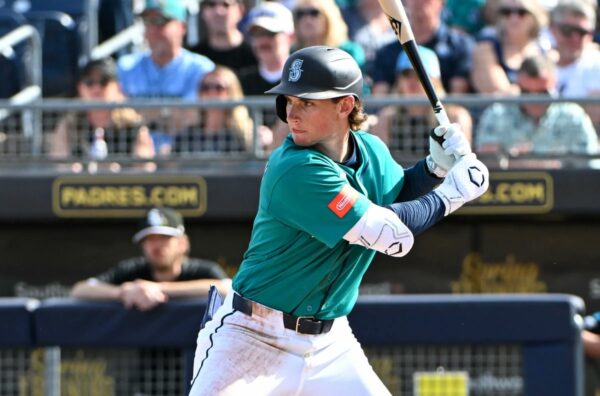
The verdict
So you’ve read and imagined the polarizing outcomes. What’s it gonna be?
In my eyes, there are too many alternatives in the baseball world to take a risk of that magnitude. Large-scale early extensions are going too far, and need to slow down. The biggest reason I jump to, is the pre-arbitration and arbitration system.
In pre-arbitration (the first three MLB seasons), players receive a league-minimum salary or slightly above it. So yes, Paul Skenes in his third MLB season, is receiving just over $1 million to play for the Pirates in 2026.
Colt Emerson will be getting paid well over $11 million in 2026, and didn’t make the Opening Day roster.
Now, salaries will jump when a player hits arbitration. However, for a developing player, this figure would predictably be smaller than the $11.75 million average annual value (AAV) that Emerson’s deal provides.
Six controllable years of a young, highly-touted player, is much more than just a “stint”. The performance and the market can decide whether the player stays or moves on, but six years can open and fulfill a competitive window.
Don’t get it twisted— the reward for successfully pulling the move will feel like a home run financially. However, out of a smaller market, a misfire of an early deal could make or break up to half of a decade for a team up front.
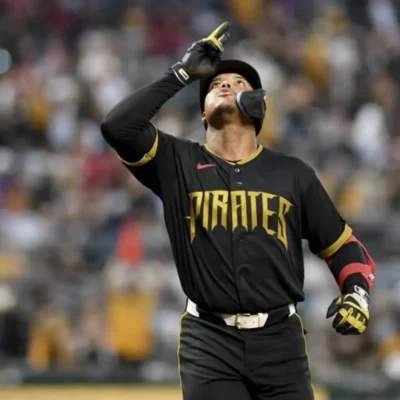
Following original publication, No.1 overall prospect Konnor Griffin signed a nine-year, $140 million contract extension to make him the highest paid player in MLB history without a day of Major League service time.
For the Pirates, the move is aggressive considering the initial reports from ESPN’s Buster Olney. As of Wednesday, Pittsburgh’s front office was reportedly in the $111 million range. While an extension was expected to come shortly, such a rapid financial jump from the Pirates is a surprise.
For baseball itself, there is clearly a new standard in place: Lock up your franchise player, before they play like a franchise player. While this might apply more heavily to a small market club, there’s little reason to expect that every team won’t buy into this method in some capacity.
The looming salary cap dispute following the 2026 season will attempt to slow down free agency. However, the new wave of extending prospects is both delaying and removing players from future free agent classes. With plenty of season left on the table, who’s knows how far this trend will progress.
At the end of the 2026 season, we’ll likely look up at Konnor Griffin as the weight that tipped the scale. If your team has a blue chip prospect in the higher levels this year, don’t be surprised if he’s taking the check at every Triple-A team dinner by September.
Opening Debut. pic.twitter.com/ILemWfjIHS
— Pittsburgh Pirates (@Pirates) April 2, 2026

41 Comments