

When you think of the Cleveland Guardians, you think of scrappiness, small ball, and fundamentals. A movie-like team with one central star and an unspectacular supporting cast, Cleveland relies on the little things. When you see “Guards Ball” online, that gritty playing style is what it means.
With a tax payroll of just over $87 million, the Guardians feature MLB’s second-lowest payroll in 2026. Their lineup is built with toolsy players who are optimized to play above their talent level.
José Ramírez, of course, is the only superstar talent on the roster. While Chase DeLauter is a budding prospect, he still has lots to prove ahead of him.
On the pitching side of things, performance has been more impressive. Starters like Shane Bieber, Tanner Bibee, and Gavin Williams are recent success stories out of Cleveland. Their bullpen is strong, although, of course, it was much stronger during the Emmanuel Clase years.
Early into 2026, the Guardians are once again reaching into their farm system for pitching. This year, 25-year-old rookie Parker Messick joined the mix for good and has quickly become a name to follow.
The expectation for an older rookie, in the fifth starter role, is quite frankly not much. Health and availability come before all, and anything below a 4.00 ERA is a bonus.
However, at the start of May, Messick is the fourth-most valuable pitcher in the sport, per Statcast run value. His 1.70 ERA also ranks fourth among qualified starters. The cherry on top? He’s averaging over six innings per start.
Paint 😮💨
Parker Messick struck out the first four batters of the game! pic.twitter.com/FHBf5LX5kT
— MLB (@MLB) April 27, 2026
So, a depth starter is pitching like the team’s ace through a month. How did Messick get here?
Resurrecting the Finesse Pitcher
An early trend breaking out in 2026 is a revival of the “mix-and-locate” pitcher. Put simply, these are the pitchers who throw a lot of pitches with a relatively even mix and exhibit great location with all of them.
Lefties of this archetype, in particular, have found incredible success. Venezuelan veterans Eduardo Rodríguez, Martín Pérez, and Ranger Suárez are each thriving in the early going. None of them throw hard, nor do they feature wipeout secondary stuff.
Messick is very much a part of this wave. With a below-average fastball velocity of 93.3 mph, the southpaw is leaning on the finesse factor. He throws six pitches, all of which he throws at least 10% of the time.
Now that’s unpredictability. If you can’t picture the challenge, just look at his swing data. Opponents chase a whopping 37.5% of his out-of-zone pitches and swing a mere 62.3% of the time at his in-zone pitches. Both of those marks are well above league average in their respective interpretations (more chases, fewer swings at strikes).
Messick is getting a good amount of swing-and-miss, placing in the top 20% of the league in strikeouts. However, the gem of his outings has been the weak contact. Messick surrenders an average exit velocity of 85.3 mph and a hard-hit rate of just 26.7%.
Parker Messick’s 2Ks in the 1st pic.twitter.com/l1uXRe6nQ4
— Rob Friedman (@PitchingNinja) April 16, 2026
Both of those marks fall into the elite category and serve as Messick’s identity. This skill is what’s helped him to pitch deep into games. The ability to get field outs keeps his pitch count minimal, allowing him to cover six to seven innings routinely.
Digging Into His Pitch Mix
Messick’s pitch du jour is his changeup, an offering that features a sharp drop to it. From his arm slot, the pitch has shades of Tarik Skubal to it, although it comes in a tad slower.
However, on top of a nasty changeup, Messick is skilled in something that Skubal actually struggles with: breaking balls. Throwing a slider nearly 30% of the time against righties, Messick’s slide piece generates more sweep than average. Paired with a sweeping curveball that he mixes in creatively, Messick utilizes the horizontal plane very effectively.
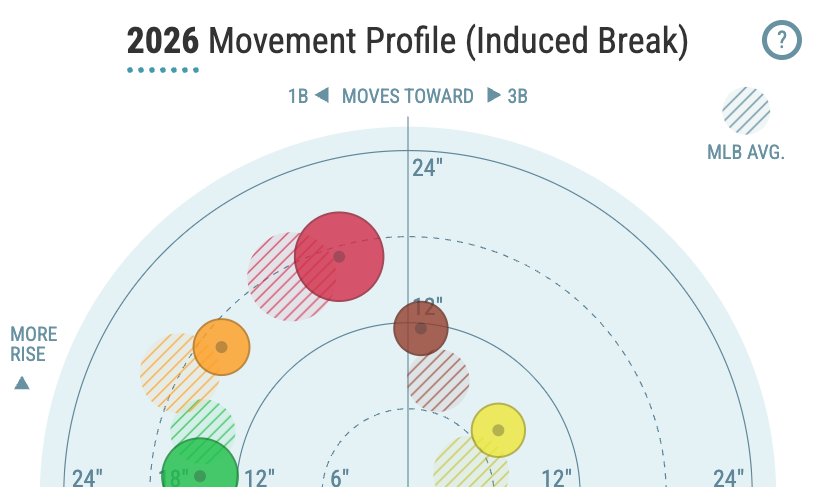
On top of three effective secondary pitches, Messick also wields three different fastballs. None of the variants are particularly advanced in their own right. However, they all play up to average individually and work off each other. Messick establishes a “fastball triangle” that prevents hitters from sitting on one fastball.
Below is his pitch movement plot, with red representing his four-seamer, orange representing his two-seamer, and brown representing his cutter. As you can see, there’s a distinct gap between their movement.
11 Comments