

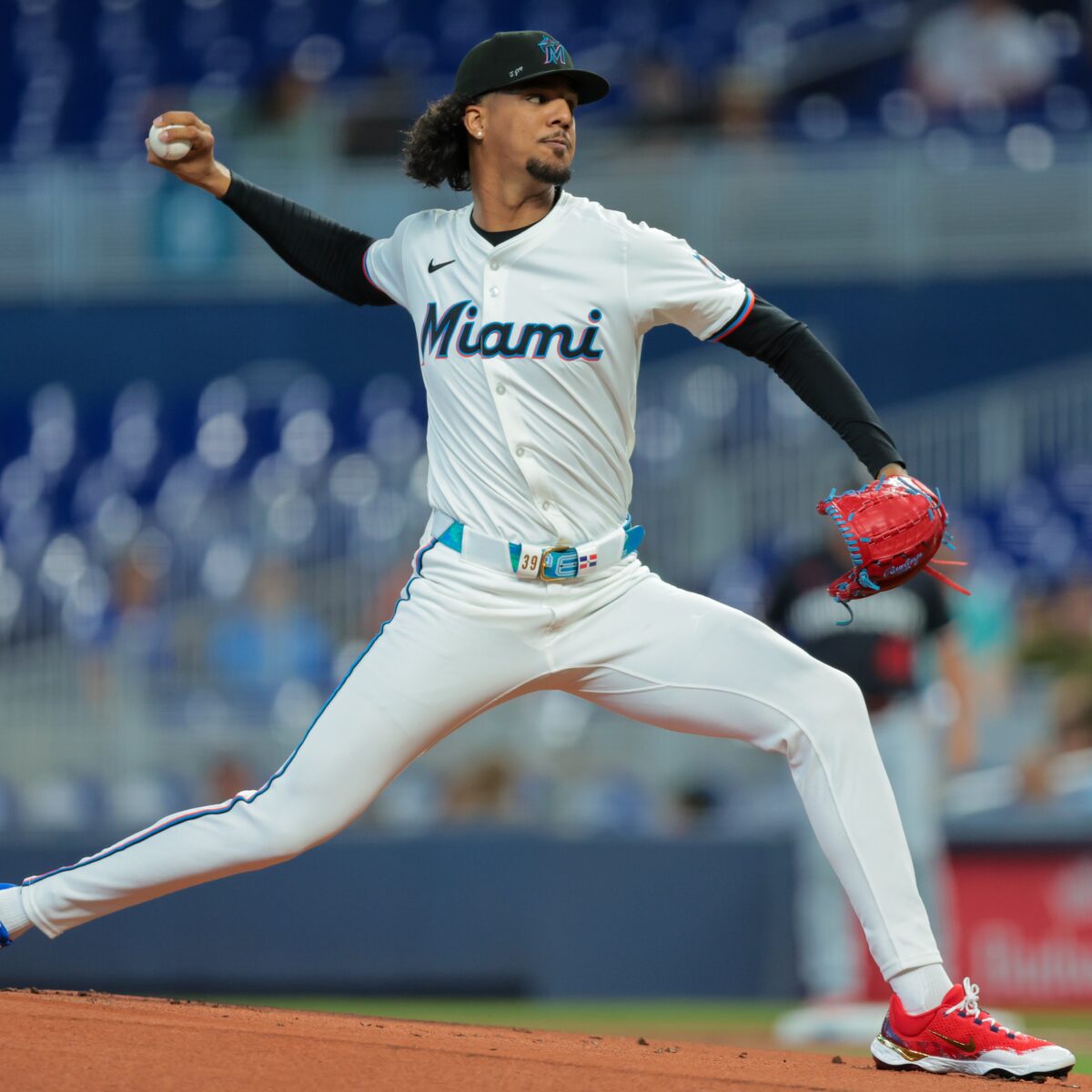
With Tommy John in the rearview mirror, Pérez has sights set on an electric age-23 season in Miami
The Marlins have watched a handful of their young arms blossom into successful starters in recent years. Sandy Alcantara’s 2022 Cy Young award certainly shines the brightest among the bunch. However, Edward Cabrera and Jesus Luzardo also put together impressive 2025 campaigns, although Luzardo’s contribution came for a different NL East team.
Miami’s track record with young starters is only going to look better in 2025. Eury Pérez, the towering Dominican right-hander, is approaching his first full season in 2026.
Debuting stateside in 2021, Pérez absolutely flew through the Marlins’ minor league system. He was called up in May of 2023, and delivered a 3.15 ERA over 19 starts in his rookie campaign. Unfortunately, an internal brace Tommy John operation eliminated his much-awaited 2024 season.
His recovery cut well into his 2025, as Pérez eased back into his role in the Marlins rotation. He finished the year with a 4.25 ERA over 20 starts, although the expected stats indicated that he performed much better than that.
In 2026, Pérez feels limitless. He’s throwing harder than he was before surgery, and now he’ll have a full Spring Training behind him to ramp up.
His premier fastball
The engine that powers all of the Eury Pérez hype is an electric four-seam fastball that simply overpowers hitters. Only six starting pitchers in 2025 averaged a higher fastball velocity than Pérez. In addition to the high-octane velocity, Pérez’s spin rate adds exceptional movement to the pitch. Take a look at the metrics:
- 97.9 MPH Average Velocity (3.4 more than MLB Avg.)
- 17.7″ Induced Vertical Break (2.6″ more than MLB Avg.)
- 10.2″ Horizontal Break (1.1″ more than MLB Avg.)
- 2686 Average RPMs (Spin Rate)
This combination of velocity and induced vertical break is nothing short of elite. The graph below highlights where Pérez’s fastball stands among his peers in those two metrics.
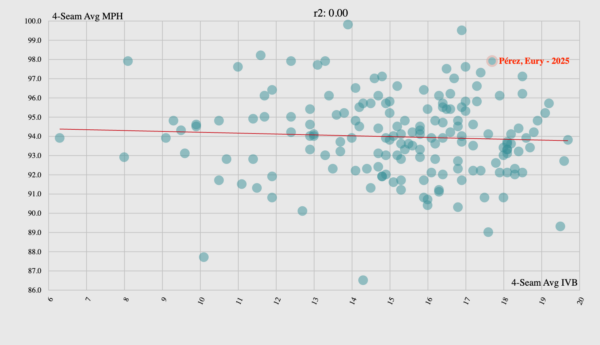
In FanGraphs’ Stuff+ metric— which grades pitch shapes— Eury Peréz’s four-seamer ranks third among all starters. His fastball tops that of Tarik Skubal, Paul Skenes, Hunter Brown, and Zack Wheeler among many others.
The hype behind the heater isn’t only found in the advanced pitch stuff metrics. His fastball merited a +10 Statcast Run Value, while stifling hitters in a variety of ways. Here’s how hitters fared against the pitch in 2025:
- Base Results – .202 AVG, .389 SLG, .295 wOBA
- Advanced Results – 21.5% Whiff Rate, 93.6 MPH Avg. Exit Velocity
Pérez threw his four-seamer over half of the time, at a 51.3% usage clip in 2025. Despite the fact that opposing hitters saw the pitch so often, they still failed to do much damage to it. The efficiency, paired with heavy usage, earned the pitch a +10 Statcast Run Value last season.
The only knock on the heater is that hitters tend to make hard contact when they do connect. However, the high exit velocities can be a little misleading.
Because of its strong induced vertical break, hitters often swing under the fastball, neutralizing any sharp contact.
Take this swing by Fernando Tatis Jr. for example. The exit velocity on this ball clocked in at 103.7 MPH. However the high-spin nature of Pérez’s fastball just swallowed the loud contact, creating an easy out.
Elite potential for command
One major takeaway from watching several of Eury Pérez’s starts is that he’s incredibly smooth on the mound. His delivery is mechanically sound and appears somewhat effortless. However, the most important piece is that the motion is repeatable, which limits bad misses in location.
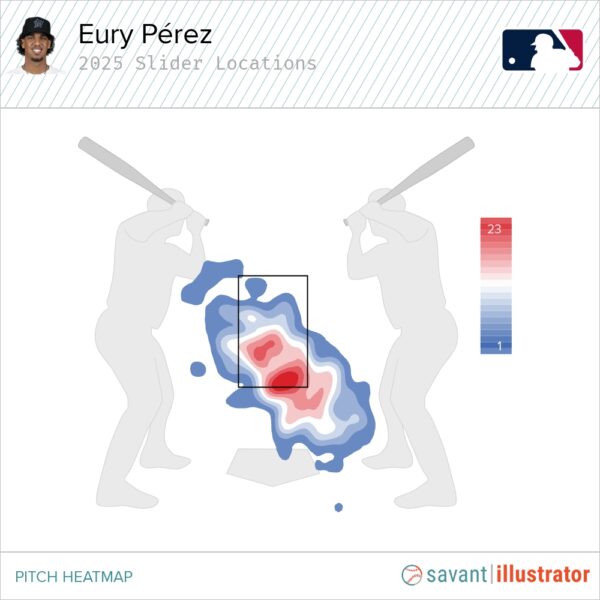
In examining his primary breaking ball, a slider, Pérez exhibits extremely advanced control. His ability to consistently bury the pitch is impressive for any pitcher, let alone a 22-year-old without a full season under his belt. Below is a heatmap of all of Pérez’s slider locations in 2025.
The fluency of his slider command bodes very well for his fastball location to improve in 2026. While it didn’t impact his results much, Pérez could be even better with his four-seamer if he locates it better. In that case, Pérez would have a competitive argument to possess the best fastball of any starter in the MLB.
Another key to making a run at the NL Cy Young is lowering his walk rate just a tad. While his current 8.3% clip mirrors the league average mark, adding the phrase “limits walks” to his scouting card would be incredibly beneficial.
Avoiding walks is often the difference that vaults pitchers from the nasty stuff discussions to the Cy Young conversations. With a delivery as smooth as any, Pérez is plenty capable of taking that next step in 2026.
Conclusion & Cy Young race outlook
In short, Pérez is not just a flamethrowing, sell-out-for-the-strikeout archetype that is growing common. Instead, he’s one of the MLB’s most gifted young arms in recent years, with no ceiling as to how good he can be. At 6′ 8, Pérez is the full package— natural athleticism, easy velocity, feel for the breaking pitch, and most importantly, tons of potential to mature and grow into a true ace.
If Pérez can make the small adjustment to his fastball location, that pitch will run the table. In 2026, a healthy Pérez will have the opportunity to blend elite strikeout qualities with productive inning eating. To many, that sounds like a Cy Young-caliber arm.
However, the path to winning the award won’t be easy. Pérez pitches in a power offensive division, and will likely pitch through the Mets, Braves, and Phillies multiple times in 2026.
Additionally, Paul Skenes is the clear favorite heading into the action, as he paced all starters in ERA the year prior. Other big names to beat will include Cristopher Sanchez, Yoshinobu Yamamoto, and Hunter Greene, who will also look to knock off Skenes.




4,428 Comments